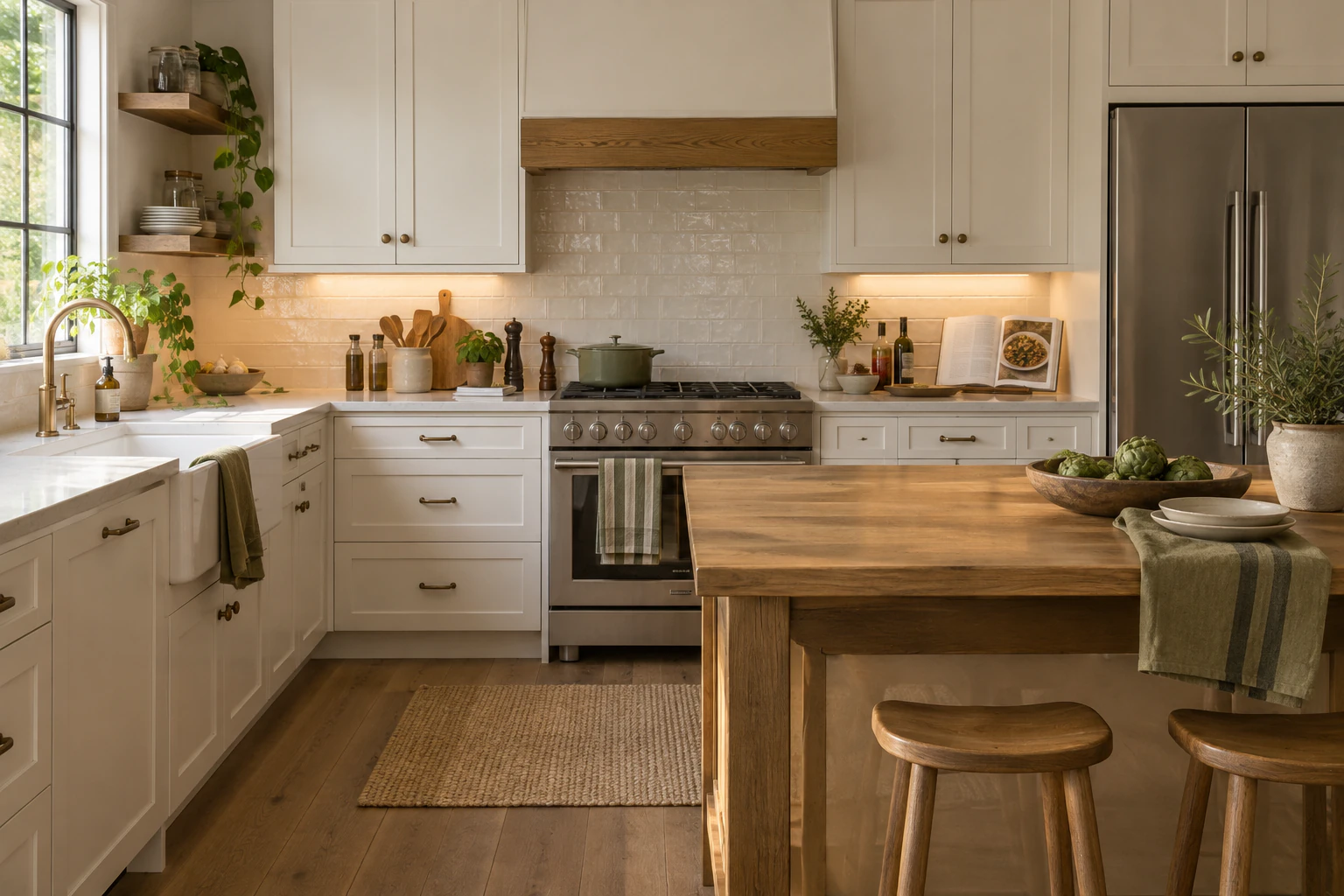
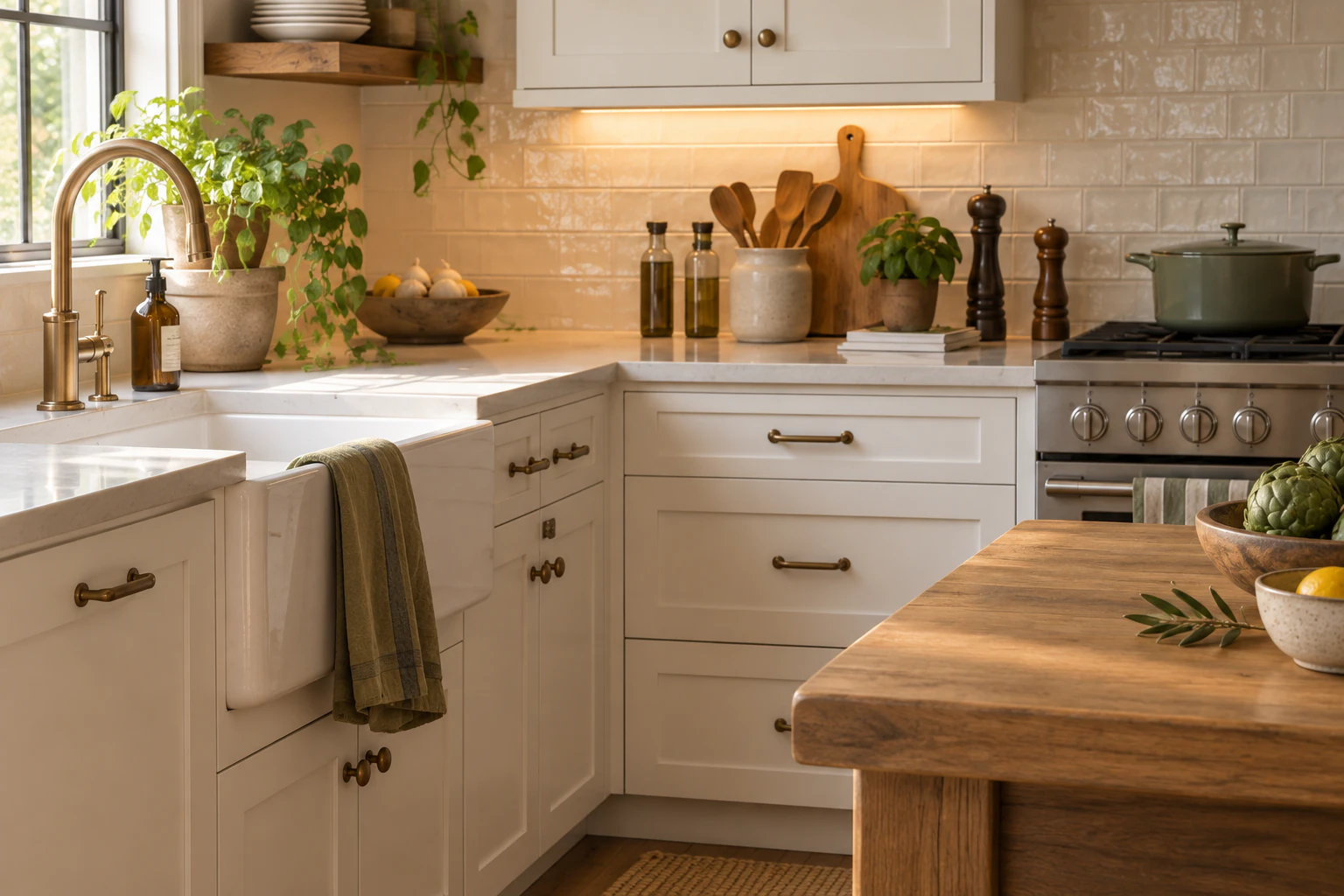
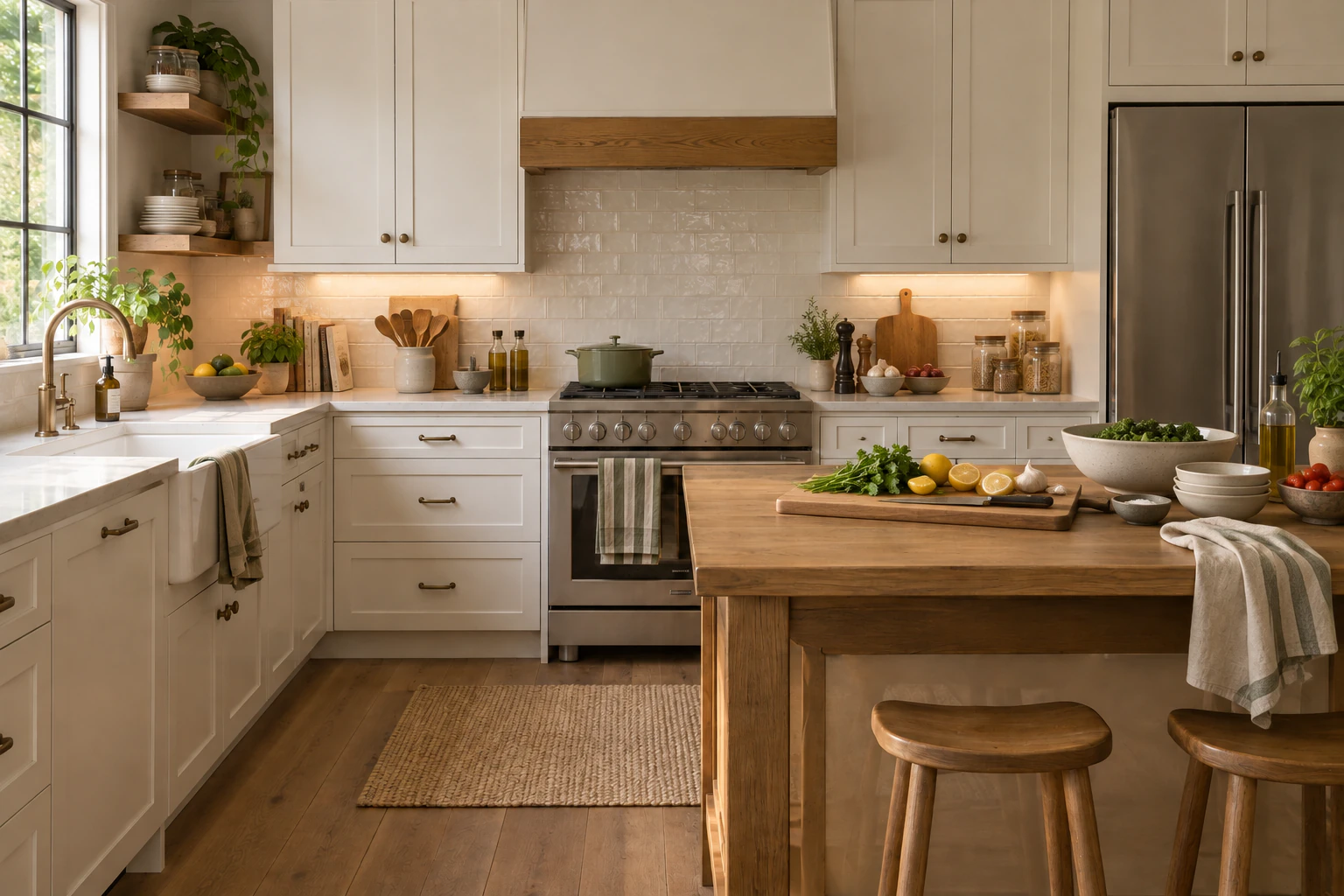
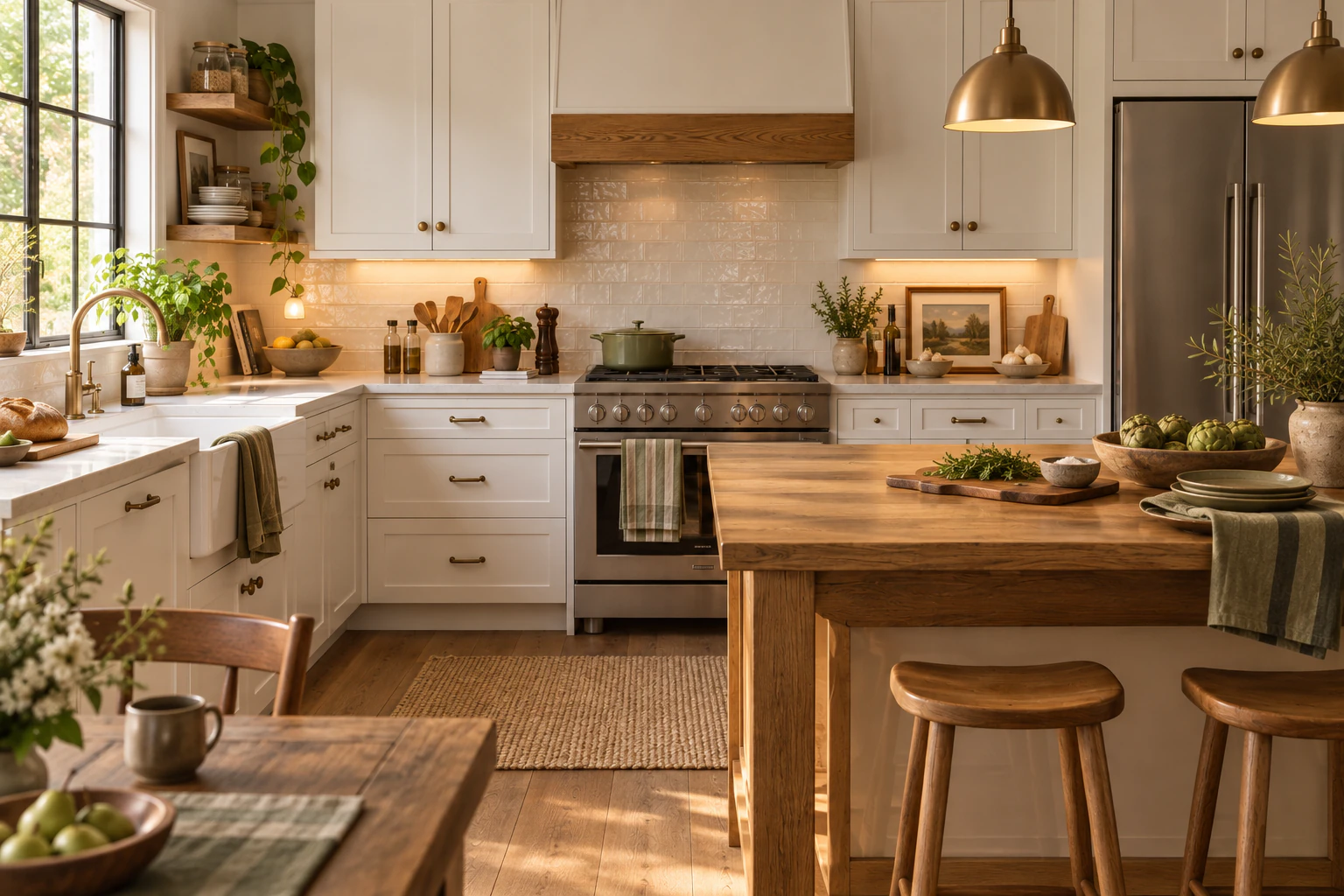
12 Kitchen Updates That Add Warmth Without a Full Remodel
A kitchen can feel more welcoming without new cabinets, a different countertop, or a demolition plan. Often, the problem is a collection of smaller frustrations: dim preparation areas, cluttered counters, awkward storage, mismatched visible objects, or a color scheme that feels disconnected from the rest of the home.
Fixing those problems can make the room more pleasant while preserving the expensive parts that still work. The right refresh improves both the appearance and the daily sequence of cooking, cleaning, and gathering.
The twelve updates below are options, not a requirement to complete all twelve. Choose the ones that address your kitchen’s actual weaknesses and leave the rest alone.
What the 2026 evidence really says
The 2026 US Houzz Kitchen Trends Study summary reports wood cabinetry at 29% and white at 28% among surveyed renovators. Its survey of 1,780 US Houzz users was fielded in July 2025. This is a narrow lead in a particular sample—not evidence that existing white kitchens must be replaced.
Elle Decor’s fall 2026 kitchen coverage also describes more personal, furniture-like touches and softer layered lighting. Our budget interpretation is to bring warmth and usability to the kitchen you already have, rather than reproduce a new renovation.
First separate decoration from repair
Before planning a refresh, identify leaks, damaged surfaces, unsafe wiring, loose fixtures, or malfunctioning ventilation. Those are repair priorities, not problems to conceal with a decorative layer.
Next, look at the work sequence. Where do groceries land? Where is food prepared? Which drawer is opened most often? Is there a convenient place for the items used every morning?
Photograph the counters before moving anything. Remove objects temporarily and group them by purpose. You may discover that the kitchen needs fewer visible items, a better arrangement, and one targeted purchase rather than a large collection of new accessories.
Set a total budget that includes tax, delivery, hardware, and professional work where needed. Decide which existing finishes will remain. This prevents a modest update from expanding into a chain of replacements.
1. Give the countertop a clear working zone
Choose the counter area most useful for preparation and keep it available. Move objects that do not need to live there, even when they look attractive together.
Group the remaining items by activity. Everyday utensils belong near their use, but they should not crowd a hot surface or obstruct a control. A frequently used appliance deserves a convenient position only when that position also meets its operating and ventilation instructions.
Measure the area left after the essentials are placed. That remaining space—not an inspiration photograph—sets the limit for countertop decor. A kitchen that can be used without moving a display already feels more considered.
2. Improve task lighting before buying decorative lighting
Look for shadows where you chop, wash, or read instructions. A brighter decorative pendant may not address a shadow cast by your body or a wall cabinet.
Identify the location that needs light, then choose an appropriate fixture and installation method. Hardwired changes belong with a qualified professional. Plug-in or rechargeable options still need suitable placement, secure installation, and safe cable or charging arrangements.
Check bulb compatibility and glare before replacing every light. Start with one problem area and assess the result during actual kitchen use. Decorative lighting can come afterward, once the room’s essential tasks are properly supported.
3. Replace hardware only after measuring it
New handles can change the appearance of existing cabinetry, but measure the distance between screw-hole centers before ordering. Overall handle length is not the same measurement.
Order a small sample when possible. Check the grip with wet or tired hands, clearance from neighboring doors, and whether the handle catches clothing. A beautiful knob that is uncomfortable to use is not an upgrade.
Inspect the existing finish underneath the old hardware. New pieces may reveal marks or outlines. In a rental, obtain permission where required and retain the original hardware for reinstatement.
Choose one consistent approach for the main cabinet run rather than introducing several new finishes at once.
4. Add warmth through a useful wooden object
A breadboard, a fruit bowl intended for food use, or a small table can introduce wood without changing the cabinets. Choose an item you need rather than a row of boards bought only for display.
Compare the wood with the floor and adjoining furniture. Deliberate contrast is often easier than trying to match an existing finish from a photograph.
Keep wooden objects clear of heat and standing water, and follow their care instructions. A decorative board should not automatically be treated as a chopping surface. The material’s appearance does not establish that it is suitable for food preparation.
5. Make one beverage station genuinely convenient
A beverage station does not require a built-in cabinet or a collection of matching jars. It needs a suitable appliance position, nearby supplies, and a straightforward cleaning routine.
Group the items used together and remove duplicate or occasional accessories. Check the appliance manual for clearances and operation; do not run a heat-producing appliance inside a closed cabinet unless the complete installation is specifically intended for that use.
Keep the station proportionate to its importance. If coffee is made once a day but the area blocks the kitchen’s only preparation surface, a smaller arrangement may be better. A useful ritual should not create a daily obstacle.
6. Add a washable textile where it makes sense
A towel, window treatment, seat pad, or suitable kitchen runner can introduce pattern without a permanent change. Start with one textile category and see whether it provides enough variation.
Consider washing, drying, and spill handling before appearance. Floor textiles need appropriate grip and should not create a trip edge or interfere with doors. Keep fabric away from cooking heat and appliance ventilation.
A muted stripe can connect existing colors without demanding that everything match. In a kitchen with strongly patterned counters, a simpler textile may be easier to live with than another competing print.
7. Put the right organizers inside the cabinets
Measure internal dimensions, hinges, shelf supports, and the clear opening—not just the nominal cabinet width. An organizer that fits the shelf may still be impossible to insert or use.
Start with the cabinet that causes the most frustration. A divider for trays, a stable shelf riser, or a better grouping system may solve that specific problem. Do not buy a full organizational system before sorting what the kitchen contains.
Check load limits and installation requirements. Make sure pull-out additions do not clash with pipes, door hinges, or neighboring storage. A successful organizer makes an existing task easier; it does not merely create a more uniform photograph.
8. Use art in a location that can support it
A small framed print or personal photograph can make a kitchen feel connected to the rest of the home. Choose a position away from heat, heavy splashing, and areas that need frequent deep cleaning.
Consider the frame surface and how it will be maintained. Secure it properly rather than leaning something unstable behind a working appliance.
You do not need a kitchen-themed picture. A landscape, a simple drawing, or a meaningful print can add character without turning the room into a themed display. Let one piece provide personality before filling every available wall.
9. Make seating comfortable enough to use
Check the relationship between the counter or table and the seat: height, legroom, support, and access. “Counter stool” and “bar stool” are not interchangeable descriptions; compare actual dimensions.
Sit long enough to notice whether the foot support works and whether getting on and off is easy. Upholstery should suit the expected spills and cleaning routine.
A chair brought from another room may be the best temporary test of whether an eat-in spot is useful. Do not create seating where it blocks a refrigerator, dishwasher, or main route. The kitchen should remain workable while someone is sitting down.
10. Refresh an appropriate painted surface
Painting a wall or trim may be more manageable than repainting all the cabinets. First determine the surface condition, preparation needed, and a suitable coating for the location.
Compare samples against the cabinets and countertop in different lighting. A warm neutral can connect the room, but a yellow-leaning shade may exaggerate a finish you already dislike.
Follow product instructions for preparation, ventilation, application, and curing. Seek qualified advice before disturbing unknown older coatings. Avoid treating cabinet painting as a simple cosmetic step when the surface or finish is unsuitable for the process you intend to use.
11. Be selective about removable finishes
Peel-and-stick products can appear convenient, but “removable” does not guarantee damage-free removal on every surface. Adhesion and removal depend on the substrate, preparation, product, and length of use.
Read the manufacturer’s location restrictions, especially around heat, moisture, and cooking areas. Get rental permission where needed and test in a discreet area only when the instructions support doing so.
Do not cover damage, block ventilation, or use a decorative product as a substitute for a required protective surface. When compatibility is uncertain, a textile, artwork, or movable item is a simpler and more reversible way to change the room.
12. Connect the kitchen to the adjoining room
Repeat one color, wood tone, or material from the nearby living or dining area. The connection can be subtle: a textile, a framed print, or a chair finish.
You do not need identical cabinet hardware and every other metal in sight. Look instead for a deliberate relationship between the largest visible surfaces. Sometimes removing a strongly contrasting accessory is enough.
Stand in the doorway between rooms and evaluate both together. This viewpoint often explains why individually attractive purchases feel disconnected. A kitchen refresh succeeds when the room belongs to the home, not when it looks like a separate set.
A hypothetical $500 plan—and what to postpone
As an illustrative allocation, reserve $200 for the biggest functional issue, $120 for carefully chosen lighting or hardware, $80 for paint or textiles, and $100 for installation needs, tax, delivery, and contingency. These are planning amounts, not verified retail quotations.
The allocation should change when the first problem is more expensive. A necessary repair or professional lighting improvement can take priority over all decorative spending.
Postpone purchases that create additional commitments. A new finish that only works with a new countertop is not a small update. A stool that needs the counter altered is not a bargain. A collection of containers that does not fit existing cupboards creates another problem to solve.
Complete the refresh in a useful order
Begin with repairs and safety issues, then sort and measure. Make the functional change next, such as improving a working light or reorganizing the most difficult cabinet.
Live with that change through normal use before adding decoration. Check whether the counter stays clearer, whether the storage is easier to use, and whether the original problem has actually improved.
Add the smallest visual adjustment that connects the remaining elements. Photograph the result from the same angle as the original image. Compare usability as well as appearance. Keep product information and unused hardware together so future maintenance does not become a guessing exercise.
Frequently asked questions
Can white cabinets still look current?
Yes. The 2026 survey does not make white cabinetry obsolete. Warm materials, suitable lighting, personal details, and a functioning layout can work with existing white cabinets.
What is the best first update for a rental?
Start with organization and movable items, then check the lease and obtain permission before changing fixtures, paint, hardware, or adhered finishes. The simplest useful improvement may require no permanent alteration.
Is a kitchen lamp a good idea?
Only in a suitable location with safe power access, adequate stability, and separation from water, heat, and work activity. It should complement proper task lighting, not replace it.
Keep the good kitchen you already have
Choose one update that improves daily use and one that adds visual warmth. Complete those before expanding the project. A kitchen that functions better and feels more personal is a meaningful improvement, even when its cabinets and countertops remain exactly where they were.
Sources
Sources reviewed October 10, 2026. Project examples are editorial suggestions; installation and product requirements must be checked for the actual kitchen.
- Houzz Pro: Wood Cabinets Are the Top Choice for Kitchens, January 29, 2026; summary of the 2026 US Houzz Kitchen Trends Study, surveyed July 2025.
- Elle Decor: The Fall Kitchen Trends Designers Say Clients Want Right Now, fall 2026 editorial coverage.