

Cozy Bedroom Ideas on a Budget: Comfort Without the Clutter
A cozy bedroom is not necessarily a room with more things in it. It is a room where the useful things are easy to reach, the lighting suits the moment, and the bed feels comfortable rather than dressed for a photograph.
Before buying another throw, identify what makes the room less pleasant today. Perhaps the overhead light is too harsh. Perhaps the curtains leave a bright gap. Perhaps spare clothes occupy the chair because there is no convenient place to put them.
Those are different problems, and they need different solutions. The most effective affordable bedroom makeover starts with the largest everyday irritation, then builds a coordinated look around the improvement.
A current look that does not require starting over
Houzz’s fall 2026 design report emphasizes warmth, natural variation, and personal character. For a bedroom, our interpretation is straightforward: use a quieter palette, a few contrasting textures, and objects that belong to your life rather than a complete matching set.
That does not mean an all-beige room. A faded blue quilt, a dark wooden dresser, or patterned curtains can be part of a calm scheme. Choose what you enjoy seeing every morning, then make the surrounding choices easier to live with.
This is a decorating guide. It does not claim that a particular color, textile, or accessory will treat a sleep problem.
Begin with a comfort audit
Spend a normal evening in the room and notice the sequence of actions. Where do you put a book, glasses, water, or charging device? Can you switch off a lamp without getting out of bed? Does opening a drawer block the route to the bathroom?
Repeat the observation in the morning. Check glare, privacy, places to dress, and where used clothing accumulates. The room may need a better hamper location more than another storage basket.
Write down three priorities and rank them. Give the first priority most of your attention and budget. If curtains are the main problem, solve the window properly before spending small amounts on several decorative objects.
Move anything that serves no bedroom purpose to a more suitable location. This is not an instruction to make the room empty. It is a way to see whether the furniture and storage you already own are enough once unrelated items stop occupying them.
Build the bed around the person, not the photograph
Choose the layers you actually use. A sheet, an appropriate comforter or blanket, and one additional layer within reach may be sufficient. More layers are not automatically more comfortable, especially for someone who dislikes feeling warm at night.
IKEA’s bedroom guidance uses bedding, curtains, and rugs to create a cozy atmosphere. Our practical adjustment is to keep those layers removable and proportionate to your preferences rather than copying a heavily styled bed exactly.
Check bedding dimensions against the mattress and the look you want. A mattress’s depth affects how much fabric hangs over the sides. Product photography may show a larger duvet or a shallower mattress than yours.
Read care labels before choosing a fabric. Consider washing frequency, drying space, household preferences, and whether a textured finish catches on jewelry or pets’ claws. A fabric that looks beautiful but creates an unwelcome laundry routine is not an affordable improvement in everyday terms.
Keep decorative pillows limited to the number you are willing to remove and store each night. A long accent cushion can provide a finished appearance without producing a pile on the floor.
Treat the window as a working part of the room
Decide what the window treatment must do: provide daytime privacy, reduce unwanted light, soften a view, or simply finish the room visually. Those functions may require different layers.
Measure the opening, available wall space, and the intended mounting position. Account for handles, vents, heating equipment, and how the window opens. Check the manufacturer’s requirements and any rental restrictions before installing hardware.
For stronger light control, coverage matters as well as the fabric. Consider gaps at the sides and top, whether the panels meet properly, and whether a lining or separate shade is needed. Do not assume a product photographed in a dark room will perform identically on your window.
A sheer layer can be useful for softening daylight, but it should not be treated as guaranteed nighttime privacy. Test the actual arrangement under the conditions in which it will be used.
For homes with young children, the US Consumer Product Safety Commission recommends cordless window coverings. Keep furniture away from accessible cords and windows as directed by safety guidance. Decorative appeal should never be the reason to retain a hazardous arrangement.
Give each bedside its own useful light
Matching lamps can look attractive, but identical objects are not necessary when the two people using the room have different needs. One may want a focused reading light; the other may prefer softer general light.
Check the switch location, the direction of the beam, and whether the shade creates glare from bed. Sit in your normal position while testing. A lamp that looks proportionate on a table can still expose the bulb at the wrong angle.
A plug-in wall light can free a surface, but it still needs secure installation and a safe cord route. A rechargeable light avoids a permanent cord while in use, but introduces charging and battery-care requirements. Choose the tradeoff that is easier for your household.
Do not use dim lighting as a substitute for enough light to move around safely. Keep the route to the door visible and select fixtures and controls that can be operated comfortably. Save elaborate lighting scenes for later; convenient everyday control comes first.
Make the bedside surface useful before styling it
Place only the objects that need to be within reach: perhaps a lamp, glasses, water, and a book. If these do not fit, the surface may be too small or the lamp may need a different position.
A drawer can hide small personal items, while an open shelf can hold a current book. Decide which function matters before choosing the table’s appearance. Check that a drawer can open without catching bedding or hitting another piece of furniture.
Two different bedside tables can work when they feel related in height, scale, or color. A large cabinet on one side and a tiny stool on the other may need visual balancing, but they do not need to be identical.
Test the height against the actual mattress top, not the nominal bed-frame height. Reaching sideways should feel natural to the user. The best dimension is the one that works with your bed and your body, not a number copied from an unrelated room.
Solve the clothing problem where it occurs
A bedroom often feels cluttered because the storage sequence is inconvenient. Clean clothing, worn-but-not-ready-to-wash clothing, and laundry need different destinations.
Put the hamper where clothes are normally removed. Give rewearable items a limited, deliberate home, such as a small rail or a few hooks installed appropriately. Keep that area bounded so it does not become a second wardrobe.
Under-bed storage can be useful for occasional items when there is suitable clearance and access. Measure the container with its lid and handles, and confirm that you can pull it out without moving other furniture. Use a storage method appropriate to the belongings and room conditions.
Avoid adding tall storage solely because floor space is limited. Stability and safe installation still matter. Follow furniture instructions and CPSC anchoring guidance for dressers and similar furniture.
Use a small palette with one personal detail
Start with the bed’s largest visible textile. Choose a wall or curtain color that works beside it, then use one darker note to give the room definition.
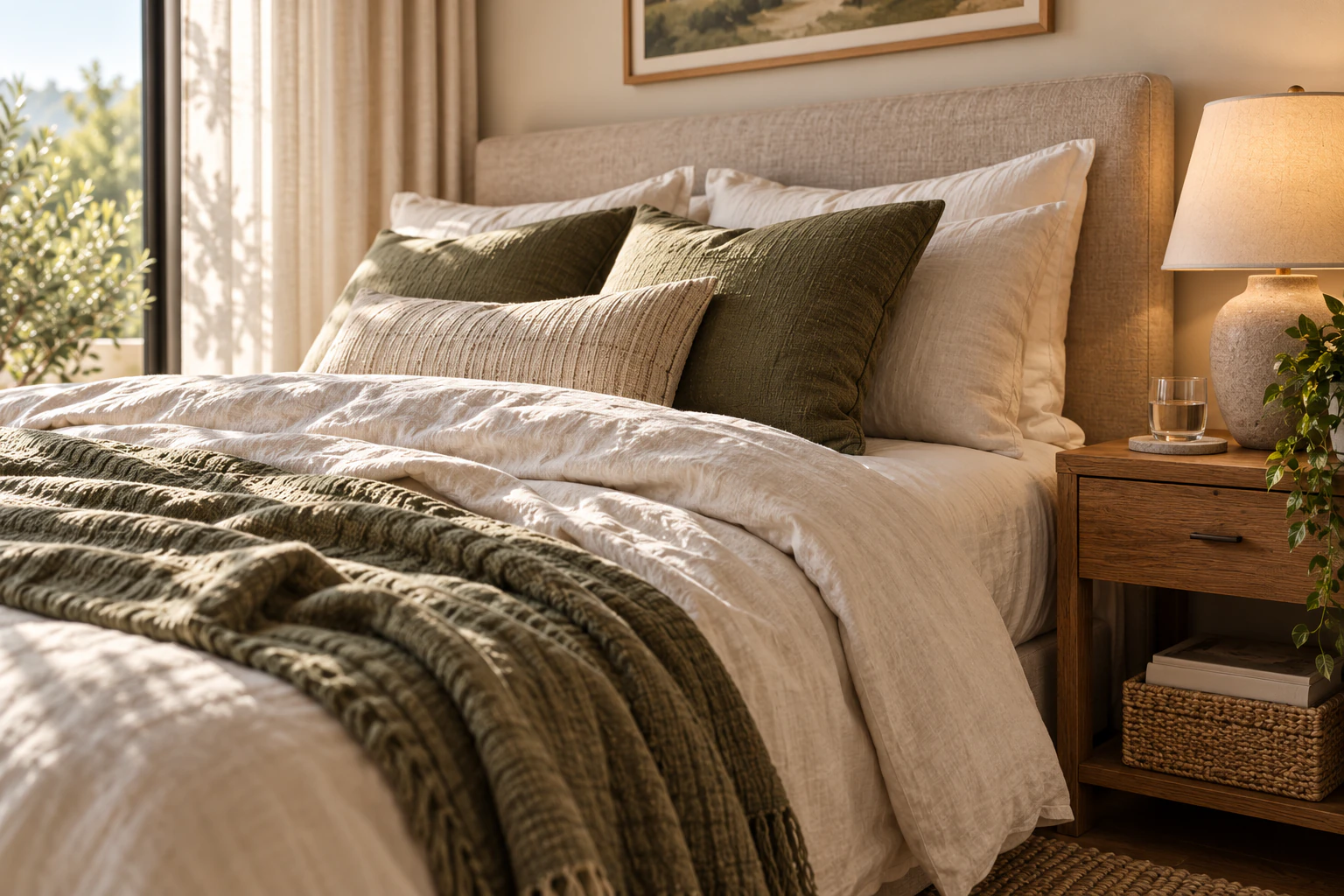
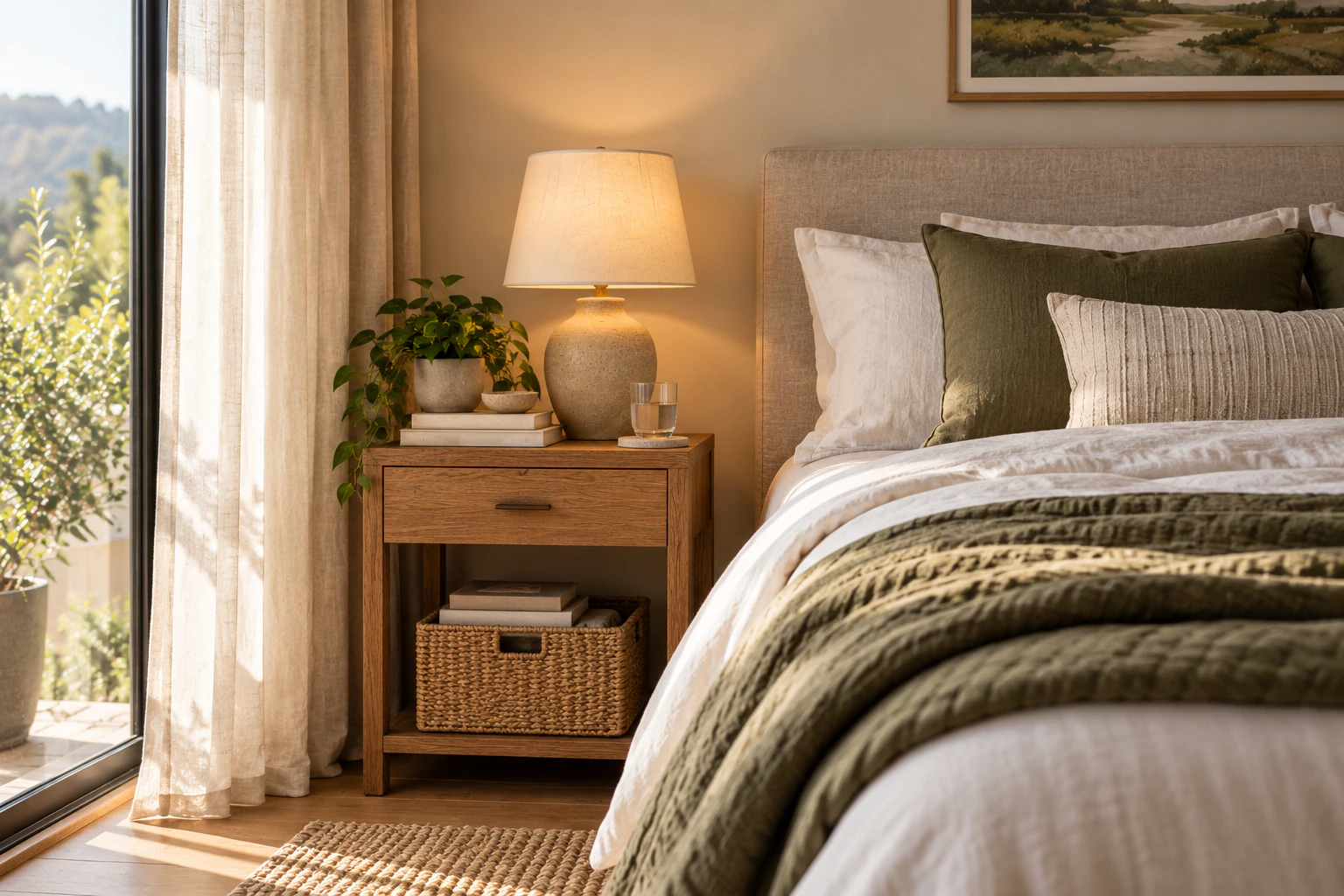
For a warm neutral example, combine soft cream, taupe, and medium brown, with olive in one cushion or a piece of artwork. For a cooler room, try off-white, muted blue, and a warm wooden bedside table. These are original combinations to test, not prescriptions.
Let one personal object break the formula: a framed drawing, a small inherited box, or a favorite reading chair. A bedroom should not become anonymous in pursuit of coordination.
Compare everything under the lighting used at night. Buying matching-looking items from different screens is less reliable than putting real samples together. When a color seems wrong, check the light before replacing the object.
A hypothetical $250 refresh
Use the following as a planning exercise, not a claim about current product prices. Reserve $90 for the most important window or privacy improvement, $70 for lighting, $50 for a bedding adjustment, and $40 for hardware, delivery, or contingency.
Reallocate according to the audit. Someone with effective curtains may put that amount toward a better bedside surface. Someone with adequate lighting may spend less and keep the difference.
The principle is to fund complete solutions rather than several half-solutions. A curtain plan that forgets the rod and installation hardware is not complete. A lamp budget that ignores the compatible bulb may leave you unable to evaluate the result.
When the required improvement exceeds the available budget, keep the room’s existing useful pieces and save toward the priority. Buying smaller distractions while postponing the main problem is rarely the most satisfying route.
Adapt the plan to your kind of bedroom
For a rental: prioritize movable lighting, washable textiles, and storage that can be installed safely within the lease conditions. Keep original hardware when permitted changes need to be reversed later.
For a shared bedroom: let each side work for its user. Coordinate the overall palette, but do not force identical lighting or storage routines where they create daily inconvenience.
For a guest room that is also an office: define a clear place for work equipment when guests arrive. Leave a reachable light, a charging location, and space for a bag. A visitor should not have to move your paperwork to find somewhere for a glass of water.
For a very small room: question the extra furniture before shrinking every essential piece. A comfortable bed with a simpler surrounding arrangement may be more useful than a crowded room containing every traditional bedroom item.
Frequently asked questions
What makes a bedroom cozy without making it hot?
Use visual warmth through color, wood, soft lighting, and a rug where suitable. Keep bedding layers adjustable rather than piling on heavy textiles that do not match your comfort preferences.
Can a white bedroom feel warm?
Yes. Compare the whites carefully, add a darker anchor, and introduce a few different textures. Lighting and the room’s fixed finishes will affect the result as much as the paint label.
What should I remove first?
Remove objects that repeatedly interfere with use: unused decorative pillows, a chair that only catches laundry, or storage you cannot open comfortably. Replace their function where necessary rather than simply hiding the problem elsewhere.
A room that is easier to live in
Choose one moment that currently feels awkward—getting dressed, reading, closing the curtains, or putting things away. Improve that sequence first. Once the room supports your routines, the decorative decisions become smaller, clearer, and much easier to keep within budget.
Sources
Sources reviewed October 10, 2026. Budget figures are hypothetical allocations; no product testing or medical benefit is claimed.